
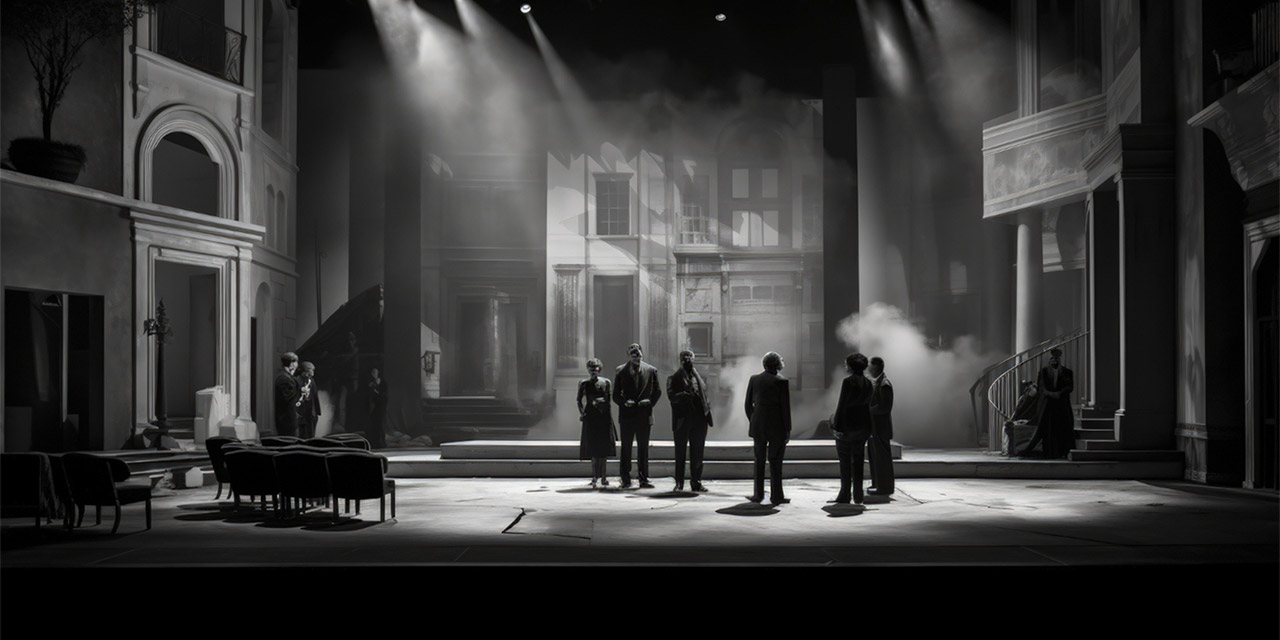
Plato’s Allegory of the Cave acts as a potent metaphor for theater or cinema, where shackled prisoners (audience) mistake shadow-plays (film/performance) for reality. The puppeteers represent creators controlling narratives, while the fire acts as the projector. It illustrates how media shapes perception, limiting understanding to curated illusions.
Theatrical Elements in the Cave:
- The Theatre/Cinema: The cave itself is a dark, enclosed space designed to restrict view.
- The Screen: The flat wall where shadows are cast acts as the movie screen or stage.
- The Audience: Prisoners chained from childhood, representing passive viewers who accept the performance as truth.
- The Puppeteers/Performers: Figures walking behind the wall with artifacts, creating the “show”.
- The Light Source: A fire providing the illumination, acting as a projector.
- The Sound: Echoes in the cave function as the film’s soundtrack or dialogue, enhancing the illusion.
Interpretation as Media/Performance:
- Illusion of Reality: The allegory suggests that like audience members in a theater, people can be manipulated by sensory media, confusing manufactured shadows with the true nature of reality.
- The “Behind the Scenes”: The, puppeteers represent those who curate what we see (media, politicians, artists), controlling the perspective of the masses.
- The Escapee: The prisoner who leaves represents the philosopher or a critic breaking free from conventional, mediated narratives to see the “real” world outside.
- The Return: The difficulty the freed prisoner has in adjusting back to the darkness highlights the, clash between critical, truth-based understanding and the comforting illusions of popular, collective, or, theatrical, narrative.
