
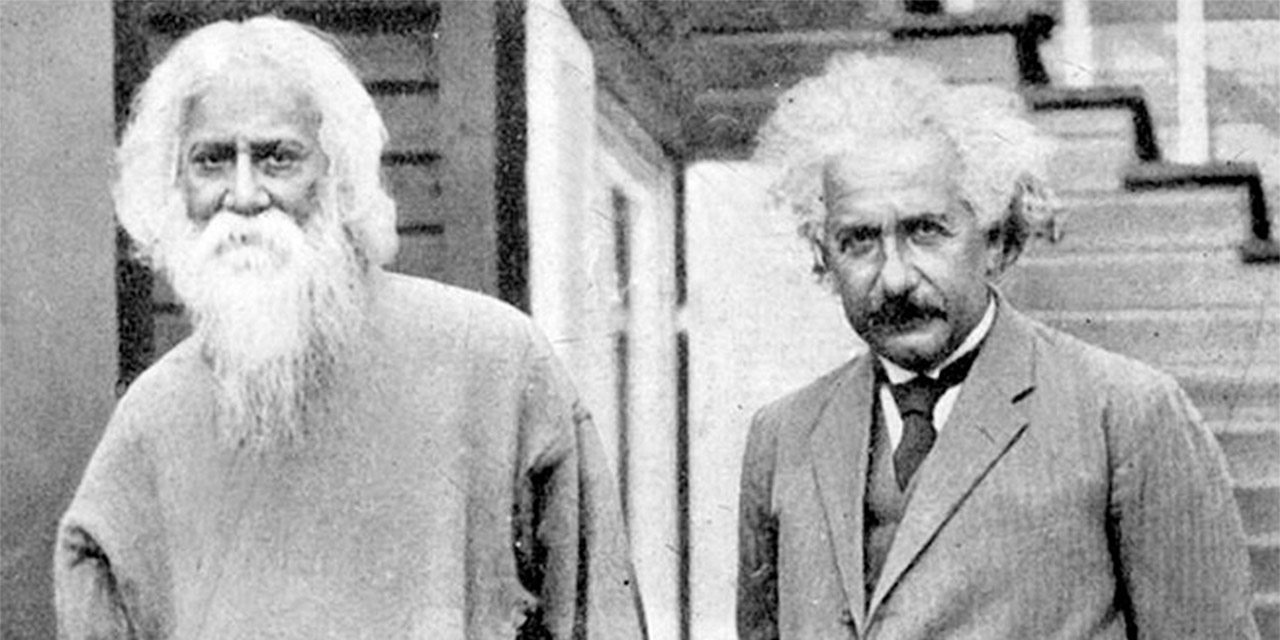
The 1930 meeting between Rabindranath Tagore and Albert Einstein remains one of the most fascinating “summits of the soul” in modern history. While their dialogue touched on the physics of reality, it was their shared language of music that bridged the gap between Einstein’s Western rationalism and Tagore’s Eastern spiritualism.
The Divergence of Sound: Harmony vs. Melody
A central point of their discussion was the fundamental structural difference between their respective musical traditions. Tagore famously noted that Western music is “linear” and “harmonic,” while Indian music is “cyclical” and “melodic.”
The Raga (Tagore): Tagore explained that Indian music centers on the Raga, a melodic framework that emphasizes emotional nuance and improvisation. It is a “solitary” journey of the soul, seeking a singular, deep connection with the universal.
The Symphony (Einstein): Einstein, an accomplished violinist, represented the Western tradition of Harmony. He viewed music as a complex architecture of simultaneous sounds, where different parts work together to create a unified, mathematical whole.
The Instruments of Expression
Their personal preferences for instruments revealed much about their philosophical temperaments. Tagore found the fixed notes of the piano “confounding” because they lacked the fluid, microtonal slides (meend) essential to Indian music. Conversely, both men shared a deep affection for the violin, an instrument capable of mimicking the human voice and expressing profound melancholy.
Scientific and Artistic Convergence
For Einstein, music was not merely a hobby but a cognitive tool. He famously remarked that he often “thought in music” to solve scientific problems. This resonated with Tagore’s belief that music is the ultimate reconciliation of the individual with the universal.
Subjectivity of Truth: They debated whether a table exists if no one is in the room to see it. While they disagreed on the objective existence of matter, they agreed that Musical Truth is inherently human—it only exists because of the human capacity to feel.
Modern Interpretations: Today, performances like “The Red Flower” (Sitar and Cello) continue to act out this dialogue, proving that while science seeks to explain the universe, music seeks to inhabit it.
This meeting reminds us that the “rational” and the “emotional” are not opposites, but two different frequencies of the same human experience.
