
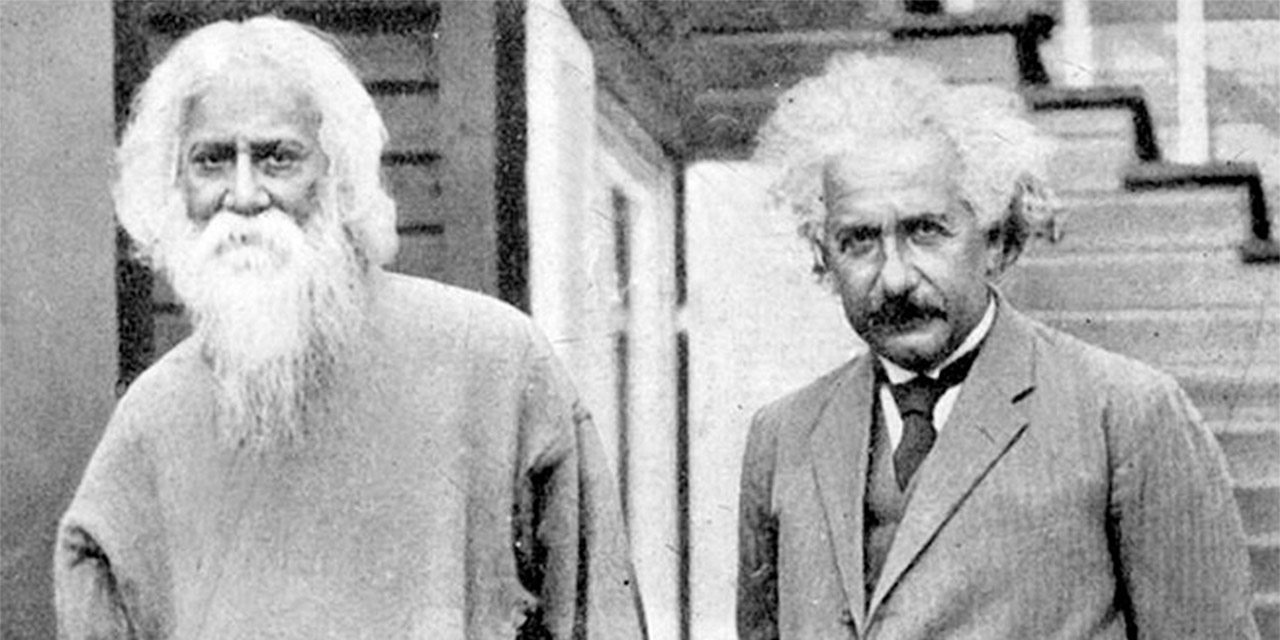
The Einstein-Tagore Dialogue (1930)
In 1930, Albert Einstein and Rabindranath Tagore met in Berlin, holding a profound, published dialogue on the nature of reality. They questioned whether truth exists independently of human consciousness. While Tagore argued that reality is relative to human perception, Einstein maintained the existence of an objective, observer-independent universe. Their discussion also covered music, science, and the “universal spirit.”
Key Conversation Themes and Quotes
The dialogue is often cited for its philosophical depth, hinging on the intersection of science and spirituality:
Reality and Consciousness: * Einstein: “If nobody were in the house the table would exist all the same?”
Tagore: “Yes, it remains outside the individual mind, but not the universal mind.”
Human vs. Universal Truth: * Tagore: “If there be any truth absolutely unrelated to humanity, then for us it is absolutely non-existing.”
Scientific Objectivity: * Einstein: “Then I am more religious than you are!”
Assertion: “I cannot prove that scientific truth must be conceived as a truth that is valid independent of humanity, but I believe it firmly.”
Music and Freedom: * Tagore: Likened Indian music to a “kirtan” that gives the singer freedom to improvise within a “too complicated music” of strict rules, unlike Western music’s rigidity.
Performance and Interpretation
The meeting has been adapted into several performances and readings:
Dramatic Renditions: Often performed as a stage reading focusing on the contrast between Eastern, subjective consciousness and Western, objective rationality.
Media and Video: Many YouTube videos analyze the dialogue, featuring summaries by scholars.
Literary Analysis: Widely published in academic and literary forums, including the Scribd PDF of the dialogue and the Marginalian.
Contextual Details
Date: July 14, 1930.
Location: Einstein’s residence in Caputh, outside Berlin.
Significance: Symbolized a meeting of Eastern philosophy and Western science.
