
Title: The Music of the Spheres
Characters:
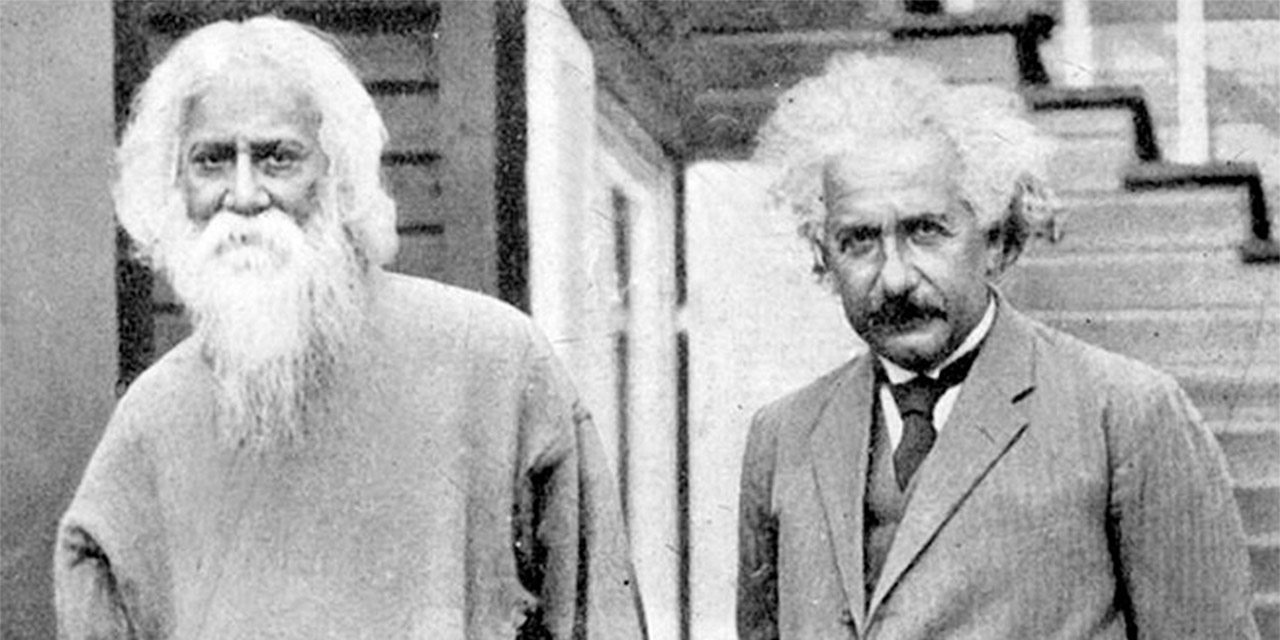
ALBERT EINSTEIN: 51. Disheveled hair, casual, holding a pipe. Methodical but curious.
RABINDRANATH TAGORE: 69. Long white beard, flowing robes. Poetic, serene, and grounded in the metaphysical.
SETTING: A sun-drenched veranda in Caputh, Germany. Two chairs face each other. On a small table sits a bowl of fruit and two glasses of water. The sound of distant birds is the only music.
EINSTEIN (Leaning forward, eyes twinkling) Do you believe in the Divine as isolated from the world?
TAGORE (Calmly) Not isolated. The infinite personality of Man comprehends the universe. There cannot be anything that cannot be subsumed by the human personality, and this proves that the Truth of the Universe is human truth.
EINSTEIN (Shaking his head slightly) But there are two different conceptions about the nature of the universe: the world as a unity dependent on humanity, and the world as a reality independent of the human factor.
TAGORE When our universe is in harmony with Man, the eternal, we know it as Truth, we feel it as beauty.
EINSTEIN (With a gentle smile) This is a purely human conception of the universe.
TAGORE There can be no other conception. This world is a human world—the scientific view of it is also that of the scientific man. Therefore, the world apart from us does not exist; it is a relative world, depending for its reality upon our consciousness.
EINSTEIN (Pausing to light his pipe) Then I am more religious than you! I cannot prove that scientific truth must be conceived as a truth that is valid independent of humanity; but I believe it firmly. I believe, for instance, that the Pythagorean theorem in geometry states something that is approximately true, independent of the existence of man.
TAGORE (Smiling) In the apprehension of truth, there is an eternal conflict between the universal human mind and the same mind confined in the individual.
EINSTEIN Even in our everyday life, we feel compelled to ascribe a reality independent of man to the objects we use. We do this to connect the experiences of our senses in a reasonable way. For instance, if nobody is in this house, yet that table remains where it is.
TAGORE Yes, it remains outside the individual mind, but not the universal mind. The table is that which is perceptible by some kind of consciousness we possess.
EINSTEIN If there would be no human being any more, would the Apollo Belvedere no longer be beautiful?
TAGORE No.
EINSTEIN (Nodding) I agree with regard to this conception of Beauty, but not with regard to Truth.
TAGORE Why not? Truth is realized through man.
EINSTEIN I cannot prove that my conception is right, but that is my religion. If there is a reality independent of man, there is also a truth relative to this reality; and in the same way, the negation of the first engenders a negation of the existence of the latter.
TAGORE Truth, which is one with the Universal Being, must essentially be human, otherwise what we individuals realize as truth can never be called truth—at least the truth which is described as scientific and which can only be reached through the process of logic—in other words, by an organ of thoughts which is human.
EINSTEIN (Leaning back, looking at the sky) Then we are both struggling with the same thing. You, through the harmony of the soul; I, through the harmony of the equations. Perhaps we are simply looking at two different sides of the same moon.
TAGORE (Softly) And the moon, Albert, only shines because we are here to see the light.
[SCENE ENDS]
